PERFORMANCE TECHNOLOGIES
Table of Contents
TogglePerformance Technologies & Self-Regulation Techniques
Unlock your peak performance with neuroscience-backed tools that transform how you manage stress, focus, and mental energy. Self-regulation performance technologies — from neurofeedback headbands to biofeedback sensors — provide real-time data about your brain and body, helping you develop practical self-regulation techniques that work in everyday life. Whether you’re engaged in mental training for peak performance, exploring mental performance training to enhance cognitive function, or seeking mind-body training to better manage physical and emotional stress, these evidence-based tools offer a clear path forward.
Evidence-based tools to train focus, manage stress, and achieve peak performance
Combined with structured practice, they support your broader mental health training journey —not as a replacement for professional care, but as a powerful complement to building resilience, awareness, and control over your internal state.
How Performance Technology Works
Self-regulation performance technologies train your brain-body connection through a simple, powerful loop:
Sense → Process → Feedback → Learn.
These devices track specific physiological signals (your body’s data), process them, and give you real-time feedback—often through a game or visual display. This feedback acts like a mirror, helping you learn to manage your internal state consciously.
Sense →
Track your body & brain signals
Process →
Analyze the data
Feedback →
Visual, audio, or game feedback
Learn
Build new habits & skills
But what exactly are these “physiological signals”? Performance technologies generally fall into two main categories based on what they measure: Biofeedback and Neurofeedback.
What Are the Physiological Signals?
Performance technologies generally fall into two main categories based on what they measure: Biofeedback and Neurofeedback
Biofeedback
Focuses on the body's physiological processes
Neurofeedback
Focuses exclusively on the brain activity
Brainwave Entrainment
A passive stimulation technique called brainwave entrainment
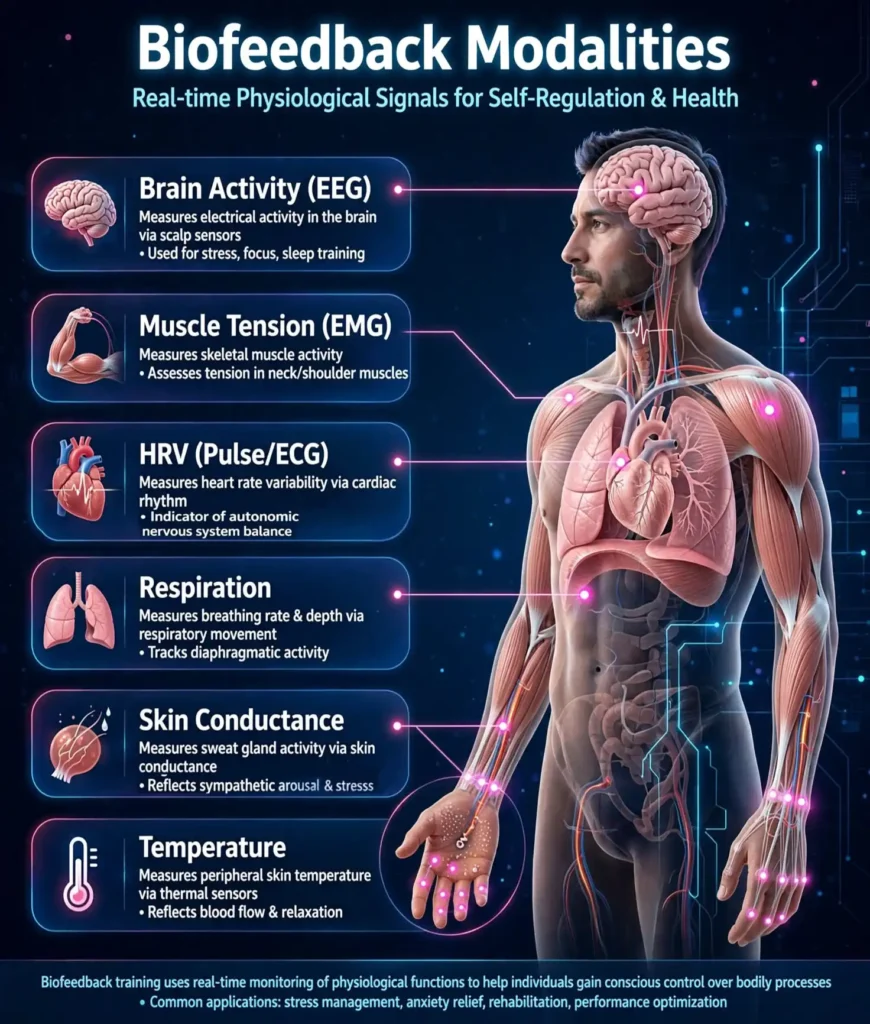
Biofeedback: Training Your Body's Signals
Biofeedback focuses on the body’s physiological processes — functions that are normally automatic but can be brought under conscious control with practice. Devices in this category track signals such as: Heart Rate Variability (HRV), Muscle Tension (EMG), Breathing Patterns, Temperature Biofeedback, and Skin Conductance.
- Heart Rate Variability (HRV) — the variation in time between heartbeats, a key indicator of stress and recovery
- Muscle Tension (EMG) — electrical activity in muscles, showing physical tension and relaxation
- Breathing Patterns — rate and depth of respiration, linked to relaxation and stress regulation
- Temperature Biofeedback — skin temperature changes, reflecting blood flow and stress response (temperature drops during stress, rises during relaxation)
- Skin Conductance – sweat gland activity, reflecting emotional arousal and stress response
By watching this data in real-time, you learn to consciously calm your heart rate, relax tense muscles, and manage your body’s stress response directly. Biofeedback is commonly used for stress management, relaxation training, and improving the mind-body connection.
Learn more in our Biofeedback Science Corner →
Neurofeedback: Training Your Brain's Signals
Neurofeedback is a specialized subset of biofeedback that focuses exclusively on the brain. Instead of measuring muscles or heart rate, it measures brainwave activity using sensors placed on the scalp. Devices in this category track signals such as:
- Brainwave Activity (EEG) – Electrical patterns in the brain associated with focus, relaxation, sleep, and other states
- Prefrontal Blood Flow (fNIRS) – Blood circulation in the prefrontal cortex — the brain’s “command center” for focus and decision-making
During a neurofeedback session, you watch or listen to feedback (like a game or sound) that responds to your brain’s activity in real time. When your brain produces healthier, more regulated patterns, the feedback becomes more rewarding. Over time, the brain learns to replicate these patterns, improving focus, emotional regulation, and cognitive performance.
Neurofeedback is typically used to train focus and attention, enhance concentration, promote deep relaxation, and build cognitive resilience.
Learn more in our Neurofeedback Science Corner →